

Following the publication of Campanus of Novara’s Latin translation in Venice in 1482, Euclid’s Elements appeared in hundreds of printed vernacular translations across the early modern period. Wardhaugh’s 2025 catalogue, Euclid in print, 1482-1703, lists 264 such editions, including examples in at least eight different European languages.
One European language that did not get a translation of Elements during this time, however, was Irish (or Gaeilge). Despite Ireland’s close connections to Britain and mainland Europe, and despite the wealth of written texts present in Irish going back hundreds of years, there is no evidence of any attempt at an Irish translation of Elements before about 1828. The first partial printed edition didn’t appear until even later, in 1908.
So, why were Irish speakers so late to the Euclidean party?
Arrival
Euclid’s Elements was written around 300 BCE. As knowledge of ancient Greek declined in Western Europe, the text gradually disappeared from circulation. There is evidence that a knowledge of certain ancient Greek texts was retained in Ireland in the early to high medieval period despite being forgotten elsewhere, and there is also considerable evidence that there was expertise in mathematics and science in Ireland at that time. However, this mathematics and science was largely based on the Computus, the calculation of the date of Easter, and there is no evidence that Euclid’s Elements was among the Greek texts in the country either before or after it was lost to the rest of Europe.
It is therefore likely that Elements remained largely unknown in Ireland until its reintroduction to Western Europe from the twelfth century onwards. At that stage, it was reintroduced to Europe by various translations which were based on Arabic editions of the text. It is not clear exactly when a copy of Elements first made its way to Ireland after this. The earliest concrete example identified is from 1596 (see Figure 1), though it is possible that it was in Ireland before this.

Linguistic and Educational Restriction
Yet even as copies of the text were present in Ireland, no attempt at an Irish translation appeared until the nineteenth century.
Around the time Elements found its way back to Europe, in the twelfth century, the Normans invaded Ireland. The country then experienced centuries of political unrest that had major consequences for Irish language education. The Penal Laws (1695-1782) made it illegal for Catholics to get an education in Ireland, or to travel abroad for one, and with the majority of Irish speakers being Catholic, these laws essentially banned schooling through Irish.
Despite this, many Irish speakers did travel to Europe for education. However, while the Irish language was present in some European colleges, there is no evidence of Euclid ever being taught through Irish in any of them. It is unlikely, therefore, that anyone was studying Elements through Irish at the time, either at home or abroad.
Traces
This does not mean that Irish speakers were totally unaware of Euclid or his work in the early modern period. Again, it is not clear exactly when or how they first became acquainted with the text, but at least some Irish speakers do seem to have been familiar with Euclid’s work by the early seventeenth century (Figure 2).
Take a look at this image, for example:
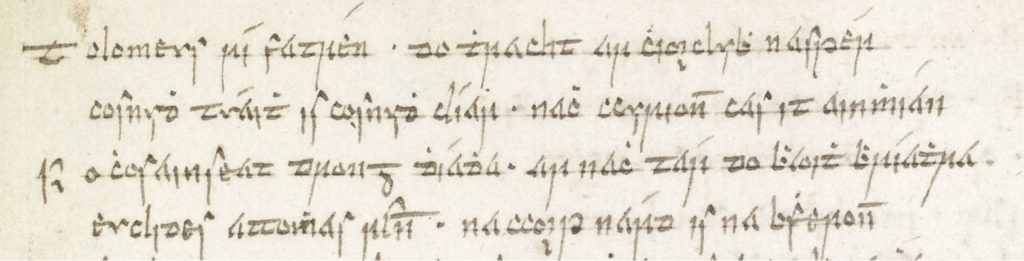
This image comes from a 1685 manuscript copy of a poem composed in the early 1600s. It is a praise poem called As follas a mheic Dáire (translation: It is clear, son of Dáire) by Roibeard Mac Artúir. In this type of poem the poet praises, unsurprisingly, the patron who has paid for the poem. The patron, in this case, is an Irish nobleman named Tadhg (mac Dáire) Mac Bruaideadha, himself also a poet.
It was common, in praise poems, for the poet to compare the patron to great heroes of mythology, or to significant historical figures. In this poem, Roibeard Mac Artúir compares his patron to Euclid.
At the start of the final line in Figure 2, Mac Artúir calls his patron “Euclides attomhas rann,” which means “Euclid in the measurement of verse.” This comparison suggests that the poet recognised Euclid as an authority on measurement, and that invoking his name was intended as praise. Also, the spelling of the name, “Euclides,” may suggest that the poet learned of Euclid from a Latin source, or from a source that was based on a Latin one. In any case, this is the earliest known written reference to Euclid by an Irish speaker.
A later reference (c. 1800) appears in a sean-nós (traditional) Irish song called Amhrán na Leabhar (Song of the Books). In this song, the singer, Tomás Rua Ó Súilleabháin, laments the books he lost in a shipwreck. One of these books was “Euclid.”
These examples show that at least some Irish speakers were familiar with Euclid and his work during and just after the early modern period, even if they encountered it primarily through English or even Latin.
It seems, then, that the absence of any attempt at an Irish translation of Elements until 1828 was not due to ignorance of the text, but rather to the limited opportunities for education through Irish. In fact, these restrictions had not ended by 1828. The national school system was established in Ireland in 1831, and it wasn’t until 1878 that the Irish language was added to the curriculum as an optional afterschool subject.
The First Attempt at Translation
This context makes the first known attempt at an Irish translation of Elements all the more interesting. It was completed by John O’Donovan, or Seán Ó Donnabháin (1806-1861).
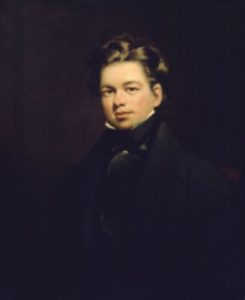
O’Donovan was one of the most influential Irish language scholars of the nineteenth century, best known for his work on Irish placenames and historical sources. Why O’Donovan became interested in Euclid remains unclear, as mathematics played no role in his formal education, or in his published works.
Regardless, O’Donovan translated the beginning of Book I of Elements, up to, and partially including Proposition 2, sometime around 1828. The translation itself is undated, but the date July 14th 1828 appears in the manuscript a few pages later. The manuscript is now held in University College Dublin Special Collections under the title Translations in English and Irish of some Euclid propositions; verse in English and Irish composed by O’Donovan; notes in English and Irish 1828 – Additional Irish Manuscript 2a.
Here are two of its pages, and a close up of the script:
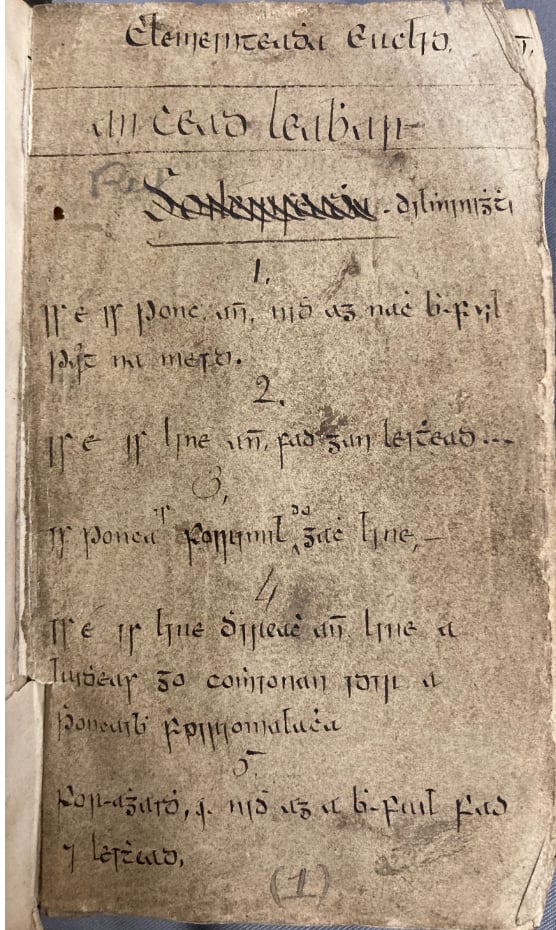
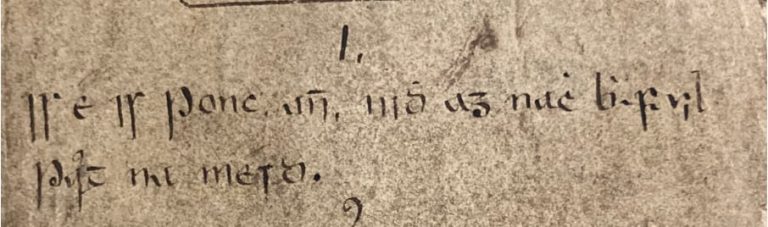
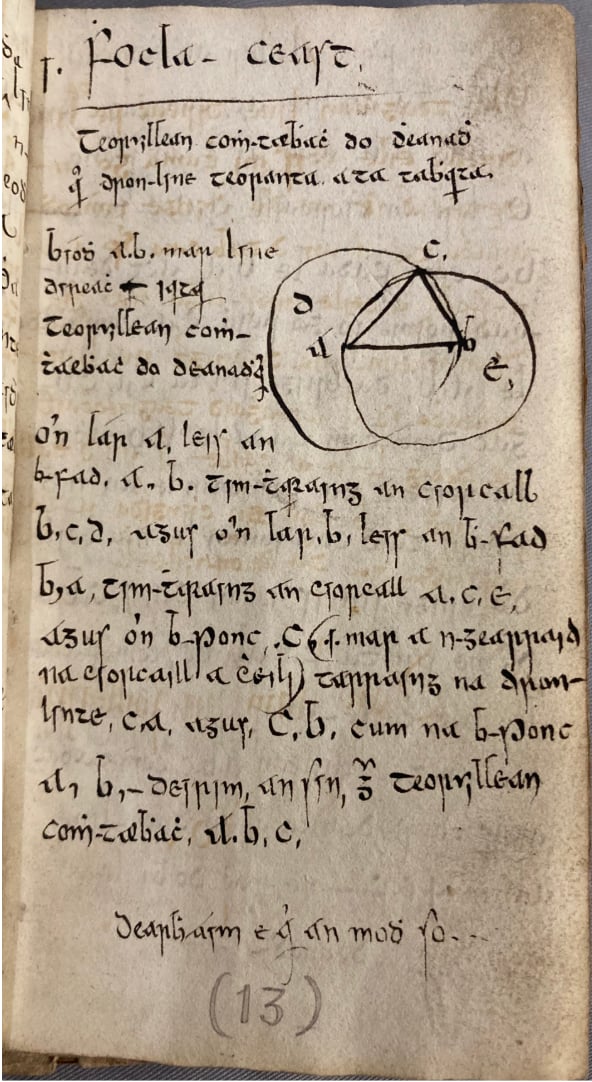
This translation seems to have been based on Robert Simson’s Elements (1756), or on an edition similar to it.
Perhaps the most interesting aspect of the translation, from an Irish language point of view, is where John O’Donovan got the mathematical terminology for this translation. There is very little evidence of mathematics being carried out through Irish for some 700 years before this, so there was no obvious source for O’Donovan to use when looking for Irish terminology. So, what words does he use?
Some of the terms in Elements, like “line,” for example, had fairly obvious Irish translations. “Líne,” in this case.
For others, O’Donovan seems to have repurposed already existing Irish words. He uses two common words – “uillinn” and “cúinne” – to mean “angle,” for example. These words normally mean “elbow” and “corner,” respectively.
O’Donovan also gives two different options for the word “circle.” The first is “crios,” a recycled word that refers to a “cloth belt.” The second is “cearcal,” which appears to correspond closely to the English term.
O’Donovan’s translation of the term “isosceles” – “comhchosach” – seems to be based on the Greek meaning of that word – “same legged.” This may suggest that O’Donovan referred to different sources for this translation, as he did not speak Greek, and Simson does not comment on the term.
O’Donovan got creative with some other terms. Starting with “square,” he used the standard translation, “cearn.” Then, for “rectangle,” he apparently coined the simple, but effective term “cearnfhada,” or “long square.” For “rhombus,” he used “cam-chearn,” or “bent square.” Putting these together provides his term for “rhomboid,” which was “cam-chearnfhada,” or “bent long square.”
The next term defined in Simson’s Elements after “rhomboid” is “trapezium.” O’Donovan left this blank.
This blank space, along with the multiple options provided for certain terms, suggests a process of experimentation by O’Donovan in these terms. This, again, makes sense, given that this work was the first of its kind that we know of.
This translation was not, however, the last of its kind.
Later Attempts at Translation
As of 2026, there is still no complete translation of Euclid’s Elements into the Irish language. John O’Donovan’s unpublished Irish translation of the start of Elements was followed by several more attempts by different Irish scholars, however.
The first of these was probably completed sometime between 1855 and 1863 by Rev. William Kilbride. Kilbride reports that he had translated the first two books of Elements, but this translation was never published, and does not appear to survive today.
The second, covering about half of Book I, was produced by the prominent Irish language scholar Fr Peadar Ua Laoghaire sometime between 1891 and 1900. It was published in a book called Papers on Irish Idiom, edited by Tomás Ó Rathile in the 1920s, after Ua Laoghaire’s death.
The final known partial translation was completed by another notable Irish language scholar, Eoghan Ó Neachtain, in two instalments. The first instalment, which covered the first book, was published in 1908. The second, which covered the second book, was published in 1913. Ó Neachtain was aware of O’Donovan’s translation, but he often used different Irish words for terms. Interestingly, Ó Neachtain’s translation of Book I may have influenced some of the terminology used by Charles Loch in his 1925 partial translation of the start of Book I into Scottish Gaelic.
Furthermore, O’Donovan’s own translation was the subject of three articles by well-known politician and scholar, Eoin MacNeill, published in the popular journal Irisleabhar na Gaedhilge in 1897, in which he also questioned many of O’Donovan’s word choices.
Taken together, these partial translations demonstrate that, despite the lack of a complete Irish version of Elements to this day, there has been a significant interest in the text and its terminology in the Irish scholarly community in recent history. It is not often that so many scholars – and prominent scholars at that – would work on translating the same text in Irish, given that the Irish scholarly community is so small. Elements is one of only a few works that has received this much attention.
Today
This ongoing project, an overlap of Irish language and history of mathematics research, may seem niche to readers. However, it is extremely relevant in modern day Ireland. Today, more students than ever are learning mathematics through the medium of Irish, and this trend is set to continue in the coming years. Despite this fact, much uncertainty still remains regarding mathematical terminology in Irish. In short, the debate that began in these partial translations of Elements has not yet been fully settled, meaning that this research is not only significant from historical and linguistic perspectives, it is also significant from a practical educational perspective.
Further Reading
Kelly, Mary, and Charles Doherty. (eds.) Music and the Stars: Mathematics in Medieval Ireland. Four Courts Press, 2013.
MacKenzie, Alison, Allen Thursten, Joanne O’Keeffe & Nina O’Neill. The teaching of KS1/2 maths in Irish-medium settings: barriers and opportunities. Queen’s University Belfast, 2018. Available at: https://pureadmin.qub.ac.uk/ws/portalfiles/portal/164462816/Final_IME_Report_7_Jan_2019.pdf.
Sandys, John Edwin. A History of Classical Scholarship. Cambridge University Press, 1903.
Wardhaugh, Benjamin. Euclid in print, 1482–1703. A catalogue of the editions of the Elements and other Euclidean works (2025). Available at: https://bibsoc.org.uk/wp-content/uploads/2025/10/Euclid_v2.pdf [accessed 19 September 2026].
About the Author
Siobhán Nic Fhearaigh is a PhD student in Irish in Maynooth University, under the supervision of Dr Tracey Ní Mhaonaigh and Dr Ciarán Mac an Bhaird.