
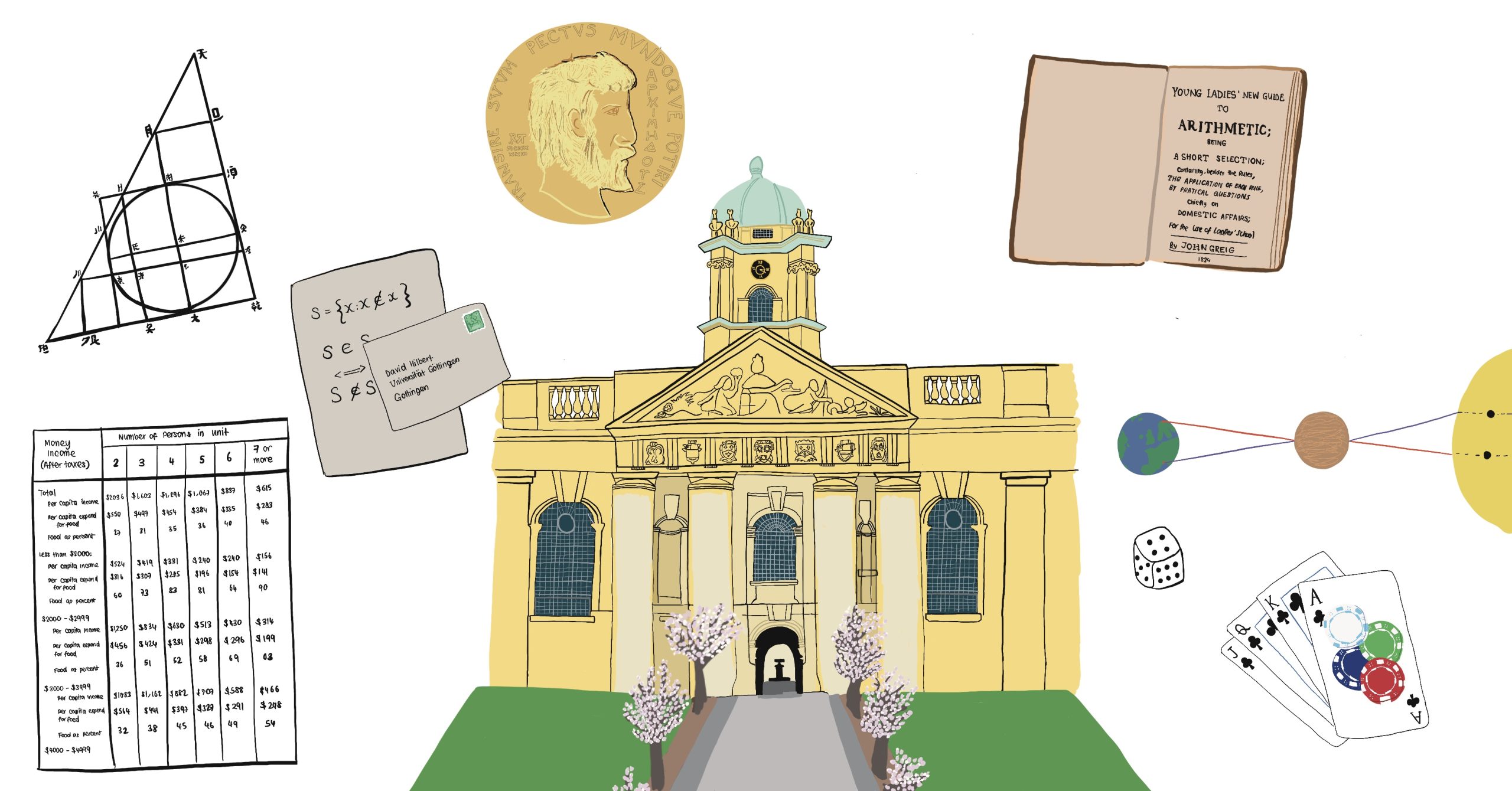
It’s the 7th of March 2026 and the cherry blossoms in the grounds of The Queen’s College are beginning to peek out, which can only mean one thing – it must be time for the BSHM’s annual Research in Progress meeting. Research in Progress is an opportunity for current students whose research centres on any aspect of the history of mathematics to present their work to a captive and supportive audience. Hosted at The Queen’s College in Oxford, the event consists of a series of short talks by students, a poster exhibition, discussions over tea and coffee, and a keynote address by an established academic.
This marks my 4th year attending, yet every year I am still amazed by the diversity of talks and the breadth of research being done in the history of mathematics. This blog post aims to give an overview of the day’s proceedings for those who couldn’t make it. I’m sure you will find at least one of the topics utterly fascinating. If so, I’d encourage you to come along for next year’s meeting – which will be sure to feature an equally varied and exciting program.
Rui Yuan – From Philology to Mathematics: What are the Relationships between the Marks and Annotations borne by the Earliest Extant Manuscript of the Chinese Mathematical Treatise Sea Mirror of the Circle Measurements and the late 18th century editions of the work?
Rui Yuan opened the talks with an exploration of the 1248 treatise Sea Mirror of Circle Measurements by Li Ye, which expounds a means (‘procedure of the celestial source’) of expressing polynomials. Thought to be lost until a circa 1780s national program to recover classical texts, an annotated edition was created by Li Rui in 1798 this edition is now considered canonical. Rui Yuan looked at the marginalia of an annotated manuscript, which reveal a chronology of ownership and corrections which either informed or followed the edition. In doing so, Rui sought to answer why a standardised text was needed, and why so soon.
Emma Baxter – Anxiety and Crisis in Early Soviet Mathematics
Emma Baxter discussed the model of anxiety and crisis, previously found in the works of Jeremy Gray, to analyse what concerns early Soviet mathematicians had, how they expressed them, and how they tried to resolve them. In this model, anxiety is both a cause of and a response to mathematical change brought about by crises, which can be foundational, metaphysical, or philosophical. Such mathematical crises often go hand in hand with personal ones. Emma gave the example of Nikolai Luzin’s spiritual crisis and how his personal circumstances reflected his evolving mathematical interests, as well as the foundational crisis, which some Soviet mathematicians suggested was linked to the economic crisis.
Petra Stanković – Between Science and Politics: The 1970 Nice International Congress of Mathematics
This talk nicely complemented Emma’s previous one, exploring the politics behind the supposedly nonpartisan International Mathematical Union and the attendance of Soviet mathematicians at ICMs. 1970 makes an interesting case study, being the first year a Soviet mathematician (Sergei Novikov) was awarded the Fields medal. This medal was awarded in absentia as the Soviet National Committee refused Novikov’s visa, perhaps because he had signed a letter opposing imprisonment of protestors in mental institutions. Petra analysed the private correspondence and public speeches of then-IMU president Henri Cartan, who recognised the ‘undoubted unease among intellectuals’ in the Soviet Union which were rooted more in personal and political affairs rather than strictly academic ones.
Elinor Flavell – Mathematical Training and Expertise in Britain 1700-1950: Education of Women
Elinor Flavell provided a highly energetic, whistle-stop tour of the first 159 days of her PhD, studying women’s mathematical training and expertise in the nineteenth century. She observed that manuals of arithmetical tables ‘for the Use of Young Ladies’ and similar handbooks were often based on Bible stories and scriptural units of measure. She then turned to Dorothea Beale’s teaching of ‘physical geography’ at Cheltenham Ladies’ College, the course being named as such to avoid objections against teaching mathematics to girls! Elinor closed by looking forward to the next ‘159+n days,’ considering the possibility of connections between institutions like Quaker schools and networks like Ladies’ Associations.
Stephen Dorman (Undergraduate Essay Prize Winner) – The Statistician’s Stomach: Mollie Orshansky and the Moral Arithmetic of Poverty
The BSHM’s annual Undergraduate Essay Prize winner Stephen Dorman rounded out the morning’s talks with an exploration of Mollie Orshansky’s work on the material cost of subsistence, contrasting the eugenic ‘technology of distance’ of Galton and Pearson. (Editor’s note: the Undergraduate Essay Prize is currently accepting entries, open to undergraduates or taught masters in the UK and Republic of Ireland, see details here).
In 1965, Orshansky published her Threshold Formula, which marked the income threshold for poverty as three times the cost of the cheapest nutritionally dense meal. She calculated this based on her previous work on the National Household Food Consumption survey, which had shown that food made up around 1/3 of a family’s budget. Much like Emma, Stephen highlighted the importance of both the national context of the emerging welfare state, and Orshansky’s personal experience of poverty to her research.
Lunch and poster display
With food scarcity in mind, a break for lunch allowed us to digest the talks thus far, the poster exhibition, and sandwiches. The posters on display covered a broad spectrum of topics, including Paolo Bonasoni’s Algebraica Geometrica of circa 1580 and its early geometric approach to algebra (Pablo Gómez Samper); mechanical harmonic oscillators used to calculate differential equations from 1890-1925 and their material construction (María de Lourdes Ortega Méndez); and a statistical analysis of Cold War mathematics in America based on the PhDs awarded (Lukas Schievelbusch).
Ties van Gemert – Gerrit Mannoury (1867–1956) on the Politics of Mathematical Logic
Via a video link, Ties van Gemert began the afternoon’s talks with an exploration of the now-obscure Gerrit Mannoury’s views on the connection between logic and socialist theory, and the coinciding ‘profound revolutions’ in mathematics and Russia. Mannoury discussed the ways rising industrialisation promoted the greater study of differential equations, and similarly how the push towards axiomatisation of mathematics reflected a political turn that became embedded in mathematical language. Ties wove in a comparison to Mannoury’s student Brouwer, who noted mathematics’ power to define and quantify experience (and thus regulate it). Mannoury on the other hand had a more aspirational view of mathematics as a tool to eliminate ideology through its transparency.
Thomas Glasman – Private Correspondence and Public Writing on the Paradoxes of Set Theory
Thomas Glasman then provided another lens on the connections between axiomatisation and politics in Germany. By assessing what was published and what was not, Glasman provided a “two-pronged” approach on the standard narrative that axiomatisation was aimed specifically to address paradoxes in set theory. Thomas argued that Bertrand Russell’s 1903 publication did not reveal paradoxes which were previously unknown, as they appear in many private correspondences before this time. Instead, it was the act of publicly calling them paradoxical which sparked David Hilbert’s ‘fervour’ to eliminate them. The ensuing discussion also touched on how the boundary between public and private blurs when letters are published, and similarities to debates on quantum mechanics occurring at the same time.
Megan Briers – Gender, Observers’ Bodies, and Nineteenth-Century Measurements of the Distance to the Sun
Meg Briers transported us back to the late nineteenth century, more specifically, to the two Venus transits of 1874 and 1882 which provided an opportunity to measure solar parallax to approximate the distance between Earth and the Sun. For the greatest precision, many measurements must be made, requiring much manpower with a military level of discipline developed through mandatory training at Greenwich. Meg focused on the gendered aspect of this labour: women’s work on these expeditions included copying observations and domestic labour in camp. The talk honed in on a specific expedition in Cairo whose leader Charles Browne battled a lengthy pay dispute with the Admiralty, as he viewed the work of those women who had paid their own way there ‘absolutely necessary.’
Shaivi Darsi (Undergraduate Essay Prize Runner-up) – From Dice to Derivatives: How 17th-Century Gambling Shaped Modern Financial Mathematics
The Undergraduate Essay Prize runner-up Shaivi Darsi discussed the importance of gambling as foundational to early probability theory and modern financial maths, as reflected in phrases including ‘playing’ the market and ‘hedging one’s bets’. Shaivi charted a course from Pascal and Fermat’s correspondence on the fairness of certain gambling games to the early financial modelling work of Louis Bachelier and his Brownian motion, noting that early financial markets faced the same critiques as gambling does today. Shaivi’s talk sparked a healthy discussion around using economic concepts to interest school children in probability.
Tinne Hoff Kjeldsen– John Fauvel Invited Lecture: A Problem-Oriented Multiple Perspective Approach to History of Mathematics Illustrated by Examples from 20th Century: how can it fill “lacunas”?
The day concluded with a keynote from an established academic speaker, this year Tinne Hoff Kjeldsen delivered the John Fauvel Invited Lecture (Editor’s note: a blog post on John Fauvel is upcoming, to mark the 25th anniversary of his death), continued her exploration of questions posed by Adrian Rice as part of the INI Modern History of Maths Program. Her talk centred on what she felt were the most specific lacunas (or gaps) in historical research and how they can be used as a tool for asking direct and specific research questions. This was demonstrated through examples from many different fields of maths, such as studying why Hermann Minkowski’s definition of convex bodies became standard as opposed to Hermann Brunn’s. Minkowski’s broader definition demonstrated more connections to other areas of mathematical study, including novel ones spawned, as the greater level of abstraction meant it could be further used to prove more general results.
About the Author
Luke Wilkes is a master’s student in the History of Science, Medicine, and Technology at the University of Oxford. His current research looks at eighteenth-century popularisations of Isaac Newton’s works targeted at women and the role of translation in spreading Newtonianism in Europe.