

Over the summer of 2026, thousands of historians of science and mathematics gathered in Edinburgh for a set of summer conferences. The BSHM supported both the workshop ‘How much: Global histories and material cultures of accountancy and metrology’ and panels at the joint ESHS/HSS annual meeting. Victoria Zwierzyk-Teles kicked off our blog series covering these events with an overview of the ESHS/HSS meeting, see here. In the second and final part of this series, Jeremy James Gray gives a run down of the ‘How much’ workshop.
After stepping up out of Waverley Station in Edinburgh and hearing bagpipes, I knew I was in the right place. Though, I did have my doubts when we were served bright, sunny weather for three whole days in a row. Attendees of the How much? Global histories and material cultures of accountancy and metrology, had quite literally, a warm welcome. I did half wonder whether Eleonora Sammarchi (University of Bern), Carlos Gonçalves (University of São Paulo), and Rebekah Higgitt (National Museums Scotland), the workshop co-organizers, had somehow also managed to arrange such excellent weather; every other aspect of the week going similarly well.
We arrived Tuesday morning at the University of Edinburgh’s impressive Futures Institute. The Futures Institute is an imposing building whose stone façade and proud turrets sit well in Edinburgh’s Old Town, but bely a sleek, tech-savvy interior befitting its name. But while our surrounds were forward looking, we historians were there to do the very opposite. But, before we cast our glance back to the past, we were first treated to a gracious welcome from Minhyong Kim, director of the International Centre for Mathematical Sciences (ICMS) which hosted the workshop, and Jane Walker, also of the ICMS and facilitator of the behind-the-scenes logistics of the workshop.
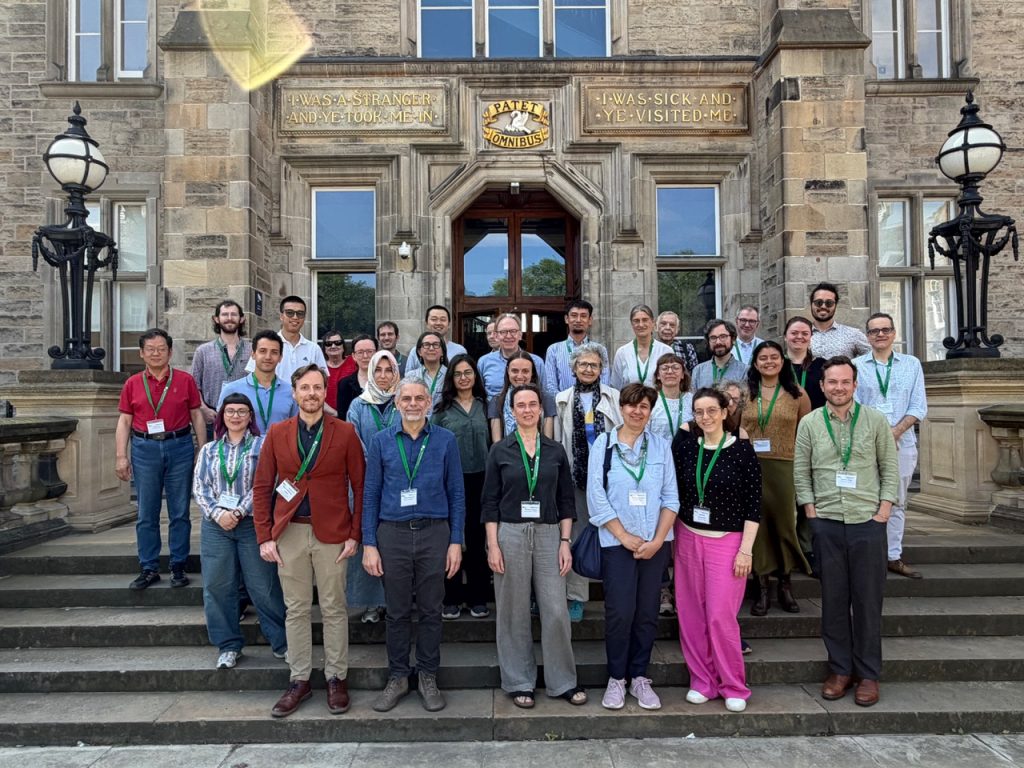
The key question raised in the workshops’ title was ‘How much?’ For us at least, the answer was ten longer talks and three shorter ones, spread over the week, which covered topics from histories of mathematics, quantification, accounting, and measurement. A commenter was allocated to every longer talk, their task being to read the paper in advance and provide a short reply following the presentation. This helped to set out themes to build on and inspire the following discussion.
What follows is a series of summaries of the various talks we were treated to throughout the week, highlighting the main themes and topics the workshop tackled. Also covered is perhaps my personal highlight of the workshop: a behind-the-scenes look into the store collection of the National Museums Scotland!
Tuesday July 7
Eleonora Sammarchi (University of Bern) – When Mathematics Meets Money: Computing Monetary Quantities in the Islamicate World
Commentator: Carlos Gonçalves (University of São Paulo)
Eleonora Sammarchi started us off with a presentation emphasizing the importance that calculation held for following various aspects of Islamic law related with money, as demonstrated by a variety of Arabic texts. She used both algebraic texts and legal texts to address how different uses of money influence mathematical practice. How, for example, to calculate the charity (Zakah) required under Islam? Or how to divide the inheritance of an estate so that each family member gets the portion they are owed? Sammarchi shared similar arithmetic problems relating to the calculations of dowry and partial salaries, which altogether showed that thinking about money motivated attempts to understand a variety of approaches to algebraic problems.
Daniel Margócsy (University of Cambridge) – The Price of Cloves: Colonial Encounters in Seventeenth-Century Maluku
For the first of the shorter talks, Daniel Margócsy joined via zoom to discuss colonial encounters in southeast Asia. More specifically, he focused on the history of what are now the Maluku islands of modern-day Indonesia. Margócsy’s presentation, part of a broader book project in progress, challenged conventional historiographies that equate histories of colonization with histories of climate change by contrasting indigenous populations as adherents of local animist religion, and colonizers as proponents of a more mechanistic, quantified cosmology. Instead, Margócsy focused on figures such as the Dutch botanist Georg Eberhard Rumphius and the local Muslim scholar Shaykh Yusuf, both of whom were concerned with polytheistic factions within their respective faiths. It was this common cause, Margócsy argued, that allowed for the exchange of natural history knowledge which facilitated the violent extraction of natural resources by colonial powers.
Laura Leon Llerena (Durham University) – Numeracy, Accountancy and the Negotiation of Colonisation in Early Modern Peru
Commentator: James Fox (University of Glasgow)
Laura Leon Llerena spoke about Spanish colonial administration in Peru, focusing on a particular case in which indigenous Andean people brought careful accounting evidence in a trial against their local priest. Encoded in Quipu, the local system of knotted ropes that carried various forms of information, precise quantities tracked by the locals showed the profit loss to the royal court as a result of the accused’s improprieties. Llerena demonstrated both the numeracy of the local populace and their grasp of how best to appeal to the authority of the colonial court. Her case study challenged the easy assumption that advanced numeracy existed solely in the colonizing population and that indigenous populations had no understanding of numbers. They clearly did, and used it effectively to argue for their rights.
Haolin Wang (Université Paris Cité) – How to Understand the Līlāvatī’s Metrology and Apply It?
Commentator: Agathe Keller (CNRS)
After lunch, Haolin Wang continued to expand the geographic bounds of the workshop with a presentation on the west Indian treatise, Līlāvatī, written by Bhāskara II, circa 1150. He focused in particular, on the metrology of the Līlāvatī, and showed how reading the notably meticulous commentaries on the base text can help interpret how the text’s practical problems mattered to everyday economic concerns. In particular, he highlighted the importance of making different units of value. The Līlāvatī, for example, equates different currencies, such as cowry shells and coins. Wang argued that the problems on currencies, weights, and capacity in the text implies a durable cognitive and administrative structure that helped make commensurate various forms of metrology across a calculable chain of grain, land, metal, and coin.
Richard Oosterhoff (University of Edinburgh) – Calculating Justice: Measurement in Early Modern Moral Philosophy
To finish our first day, Richard Oosterhoff provided another of the workshop’s shorter talks by sketching out the beginnings of a new book project he is undertaking. He proposed a focus on how thinkers resort to mathematics to consider problems of balance, harmony, and equation in addressing problems of ethics, focusing on two case studies: the French humanist Jacques Lefèvre d’Étaples and the German reformer Philipp Melanchthon. Building on Lorraine Daston’s distinction between thick and thin rules, he suggested that over the course of the early modern period in Europe there was a shift from thick rules, in which human judgment was necessary in considering individual cases, to more algorithmic thin rules, that allowed non-mathematicians to use numbers to bind human concerns of justice and ethics to metrology.
Wednesday July 8
Carlos Gonçalves (University of Sao Paulo) – Amounts, Interest, and Conditions in Loan Contracts from the Old Babylonian Diyala: the Archive of Ilšu-Nāṣir from Nērebtum
Commentator: Jens Høyrup (Roskilde University)
To begin the second day of the workshop, Carlos Gonçalves led us through a crash course on the complexities of deciphering Old Babylonian clay tablets. He shared, in particular, a few examples from a collection that includes what might be best described as the clay tablet version of marginalia, in which impressions of various numbers were made along the edge of the tablets. What’s tantalizing in the examples he has been studying, tablets accounting for different grain contracts, is that these marginalia might be examples of the working out of the arithmetic for the numbers involved. Unfortunately, issues remain, as the numbers rarely line up the way one would hope. Moving forward, however, Gonçalves hopes to use careful comparisons between different types of tables, in conjunction with the cultural contexts in which tablets were made, to further decipher what these mysterious numbers might be doing.
Clelia Crialesi (SPHERE Laboratory, Université Paris Cité) – Something That Can Stand for Anything: The Unknown Against the Backdrop of 14th-Century Accounts of Quantity
Commentator: Nicolas Grégoire-Véyrié (University of Bern)
Cleila Crialesi provided a perspective from the history of philosophy on different aspects of unknown variables in algebra, and how they were preserved throughout translations from Arabic sources into Latin and finally vernacular languages. She was especially interested in the possibility that the semiotic character of the unknown in pre-modern times arose first through commercial exchange, rather than mathematical culture. She argued for three unchanging characteristics of the unknown: procedural, categorical, and semantically generous. The procedural aspect, as she described it, is circumscribed by operational intent; it remains indeterminate in advance of procedures for finding determinate value. As a category, unknown variables are understood to be quantities. And finally, the unknown is semantically generous, that is to say, it’s universally applicable. Crialesi traced how different traditions and languages preserved each of these aspects of the unknown to varying degrees in mathematical texts.
Célestin Xiaohan Zhou (The Institute for the History of Natural Sciences, Chinese Academy of Sciences and University of Edinburgh) – Accountancy in Fifteenth-Century Chinese Mathematical Texts: Its Sources and Applications
Commentator: Maedeh Hosseinzadeh (University of Bern)
Célestin Zhou presented on Wu Jing, the fifteenth-century mathematician and accountant. Zhou is interested in how Wu Jing’s contemporaries viewed him, despite very little being known of Wu’s life. He may have been an assistant to local administrators, or perhaps a private teacher of mathematics. As an author, Wu seems to have focused mostly on compiling existing knowledge, and especially making it more teachable and easier to understand. In this, Wu is part of a larger tradition in Chinese mathematical texts that encodes mathematical teaching in verse, poems, and ‘pithy formulas’. Zhou is interested in the possibility that these ‘pithy formulas’, and other visual aids associated with them, were derived from counting rods. Notably, in Wu’s work, such teaching aids were directed towards practical challenges, mostly to do with specific problems in accounting.
Taro Tokutake (SPHERE Laboratory, Université Paris Cité) – Numerical Configurations of “Conversion of Several Bonds into One” (ekapattrīkaraṇa) in Manuscripts of Śrīdhara’s Three Hundred (Verses) (Triśatī)
Commentator: Zehra Bilgin (University of Edinburgh and Istanbul Medeniyet University)
Taro Tokutake presented on an arithmetic text by the ninth-century Indian mathematician Śrīdhara, which is a collection of three hundred verses on different mathematical topics. In particular, he focused on problems in the text which show how to combine several bonds of different rates into one. Tokutake put all these calculations into modern notation in an attempt to reconstruct how the calculations were performed in the original text. While many of the details of the computations remain unclear, Tokutake hopes to compare these results with other sources that detail loan payments in daily commercial life and state affairs to further decipher how the calculations were made.
Raffaele Danna and Jip Van Besouw (both Sant’Anna School of Advanced Studies) – Manuals of Practical Mathematics as Objects and Sources of Knowledge in Late Medieval and Early Modern Europe
Commentator: Veronica Gavagna (University of Florence)
Raffaele Danna and Jip Van Besouw presented together on how the complexities of the European monetary system implied a problem of trust that was solved in part by precision weighing of different currencies. While, in principle, coins were meant to represent the intrinsic value they contained, this was not necessarily true in practice. The difficulty of the problem is particularly evident in examples of alloying calculations from practical manuals on arithmetic. Another set of prominent sources they focused on were Dutch books on money, in which lists of various values and weights of coins are accompanied by examples of monetary arithmetic. Danna and Van Besouw showed how persistent a problem the different valuation of coins was from the 1250s through to the periods of Galileo, Kepler, Boyle, and Newton, all of whom provided different solutions for improving accuracy in testing the weight and purity of coins.
Thursday July 9
Christopher Hollings (University of Oxford) – Modern Understandings of Ancient Egyptian Metrology
Commentator: Karine Chemla (University of Edinburgh)
Kicking off our third day, Chris Hollings (current BSHM president) showed how modern understandings of Ancient Egyptian mathematics were the result of rationalizations based on modern understandings of mathematics. This meant there was often an overemphasis on examples deemed mathematically interesting, including tantalizing possibilities of Ancient Egyptians algebra. In terms of metrology, approaches differed, with some scholars letting mathematics lead, while others focused more on broader contexts provided by philology and archaeology. As a result, interpretations varied widely. While some argued that Ancient Egypt possessed a standardized system of weights and measures, others argued for an ad-hoc system of measurements aimed primarily at solving practical and administrative considerations. Hollings showed how these variations in methodology and conclusions are representative of modern disciplinary differences. Although metrology was clearly a central feature of Ancient Egyptian mathematics, it remained within the purview of Egyptologists and played only a relatively minor role for historians of mathematics.
Jane Wess (Independent Scholar) – Social Considerations in the Use of Instruments: The Hypsometer
Commentator: Deborah Kent (University of St. Andrews)
Jane Wess finished the morning by tracing the development of the hypsometer. The hypsometer was essentially a thermometer with a heating element. By finding the temperature at which water boils, it can determine barometric pressure, making it an instrument for measuring elevation. Although it received little attention at the point of its invention in the mid eighteenth century, it came to be adopted by explorers, particularly as European geographical exploration shifted from predominantly maritime expeditions to more land missions. As an example, the Royal Geographical Society adopted it over the course of the nineteenth century as hypsometers became smaller, more convenient, and easier to travel with. The use of hypsometers grew despite their relative lack of accuracy and precision, which Wess argued highlights the importance that social considerations played in the choice of scientific instruments for different tasks in the field.
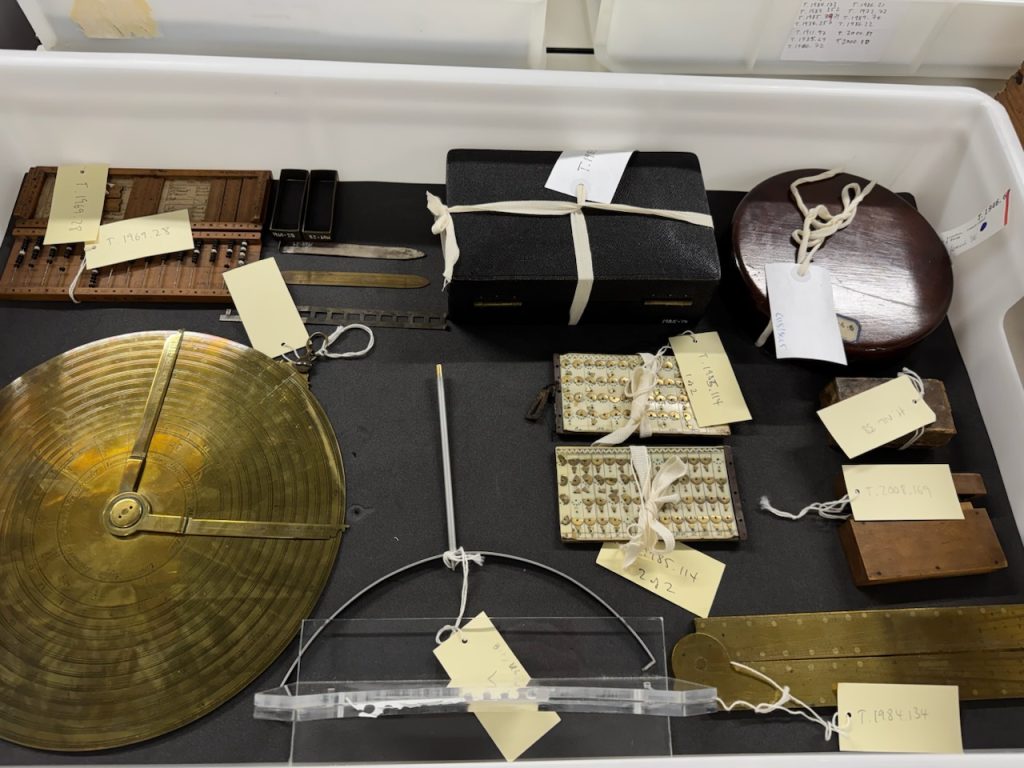
On Thursday afternoon, after our usual catered lunch, we were treated to a field trip that I think marked the highlight of the week for many of us. Thanks to Rebekah Higgitt, Principal Curator of Science for National Museums Scotland and one of the workshops co-organizers, we got a behind-the-scenes look at the museum’s main collection store. After figuring out the right bus, we found ourselves in the northern reaches of Edinburgh’s outskirts amid a cluster of unassuming warehouses. With security badges in hand, we split into groups that hopped from one storage area to the next, where curators had pulled out objects of interest for us to view. We saw ancient Mesopotamian cuneiform tablets detailing debt contracts and legal cases to do with dowry, Chinese and Japanese abacuses from several periods, counterweights for measuring coins from what is now Myanmar, Indonesian string line for measuring land areas, an early British surveyor’s wheel, thermometers, barometers, and so much more.
Aside from the objects pulled out of storage for us to see, simply walking through warehouse after warehouse was staggering. There was just so much stuff – things, of every description. We saw jet engines, printing presses, a lighthouse lens, engines of every type and the flare tip from a decommissioned oil platform in the North Sea! There were rows of bicycles, motorcycles, and a steam shovel. We saw early computers the length of a warehouse and early Napier’s bones the size of a matchbox. The scale and scope was dizzying, and we saw only a fraction. There was a constant temptation to start wandering off into the dark end of a warehouse, curious to see what treasures lay beyond. It was all a real treat to witness, and made for a pleasant change of pace before our last day of talks…
Friday July 10
Robert Middeke-Conlin (Max Planck Institute of Geoanthropology) – Culture and Environment: The Cognitive Factors of Mesopotamian Value Conception
Commentator: Thomás-Haddad (University of Sao Paulo)
Friday morning we again returned to thinking about ancient Mesopotamia as Robert Middeke-Conlin presented on innovative methodologies that might assist us in thinking about cuneiform tablets. In particular, he proposes the use of approaches borrowed from cognitive psychology, noting the extent to which cognition is connected to culture. He argued that this methodology can connect the definition of value as a cognitive process with cultural conceptions of value that are related to scarcity. His focus was the Old Babylonian scribal school tradition in which many cuneiform tablets were created. If the brain learns through considering written representations as objects, Middeke-Conlin argued that cuneiform tablets originating in the scribal school tradition, which taught students to solve problems of practical accounting, are material examples of joint action creating a shared mental model of what value is. This interdisciplinary approach could provide a new starting point for thinking more broadly about the mathematical culture of ancient Mesopotamia.
Laurent Mazliak (Sorbonne Université) – Émile Borel and Probability as a Scientific Tool for the Citizen
Commentator: Caroline Ehrhardt (Université Paris 8)
Laurent Mazliak joined us on zoom to talk about the career of the French mathematician Émile Borel, who developed innovative approaches to quantifying risk using probability in the late nineteenth and early twentieth century. Having been raised Calvinist, it’s intriguing to consider that his interest in questions of certainty and chance began by thinking about pre-destination. More certainly, he was inspired by the thought of Voltaire, whose belief in probability as an essential way of seeing the world influenced Borel for the rest of his life. During WWI, Borel turned to state matters and was involved in the founding of several institutions, notably the Henri Poincaré Institute and the Paris Institute of Statistics. Later in life he expanded his interests, considering how game theory and probability could be applied to practical contexts of insurance and gambling. More broadly, Borel felt that probability was fundamental to experimental science as logic was to mathematics.
Sonja Brentjes (University Wuppertal) – Numbers and Their Forms and Usage in Two Books of the Mathematical Sciences: ‘Abd al-Rahman al-Sufi’s Kitab suwar al-kawakib al-thabita and ‘Abd al-Rahman al-Khazini’s Kitab mizan al-hikma
Our final short talk came from Sonja Brentjes, who focused on al-Sufi’s Book on the Images of Fixed Stars and al-Khazini’s Book of the Balance of Wisdom. There are no originals of either text, so what we know comes from copies that notably contain a multiplicity of words and number representations to record quantities. Although copies of Al-Sufi’s text do not seem to contain much systematic usage of one representation over another, the variation in copies of al-Khazini’s text seem to follow more clear patterns. For example, Brentjes argued that certain number systems were used primarily in tables for aesthetic or organizational purposes. Although she was reluctant to draw any definitive conclusions based on the available material, Brentjes argued that with further study copies of al-Khazini’s text may yield an understanding of the reasons behind the intentional presence of different numerical representations for different purposes.
Michael Barany (University of Edinburgh) – Accounting Ideals in Modern Mathematics – Discussion with J.P. Archer, Jan Vrhovski, Bo van Broekhoven, Patricia Rogers, and Susannah Glickman
The final presentation of the workshop deviated in format from the previous presentations as Michael Barany chaired a roundtable discussion including five other researchers. The group’s research is inspired by Ted Porter’s work on accounting ideals in science, as they ask instead what role such ideals play in mathematics more particularly. Discussion focused on themes like checking, the very act of noting with a checkmark on accounts, and its relationship to verification and enumeration. A specific example discussed at length was the Rockefeller Foundation. As a prominent funder of mathematical research, the foundation’s archives provide a wealth of evidence for how methods of accounting impact the direction of mathematics. Research fellowships, for example, were tracked for return on investment, though not necessarily in quantitative terms. The discussion then turned to the twentieth century’s increasing use of technology to speed up computation, in both accounting but also in the formalization of mathematics. Despite the ever increasing abstraction, however, perhaps the practical concerns accounting addresses still matter, especially given the growing influence of funding bodies.
Our final roundtable’s discussion on modern mathematics was a good way to wrap up the week, as it brought the themes of the past we had explored over the course of the workshop right up to the present day. The range and diversity, in both place and period, of the topics presented over the week was astonishing. The global in global history felt very well represented. As someone based in a broader history faculty, it can sometimes feel like anything early modern is in the mists of time, but several presentations on the ancient world made even the nineteenth-century feel positively recent. Despite this range, the topics presented over the week fit remarkably well together, and served as a potent reminder that ideas of value, processes of metrology, and methods of accounting should lead, rather than follow, in histories of mathematics.
About the Author
Jeremy James Gray is a doctoral student at the University of Oxford. His research examines the mathematical practice of minting and assaying in late seventeenth-century England