
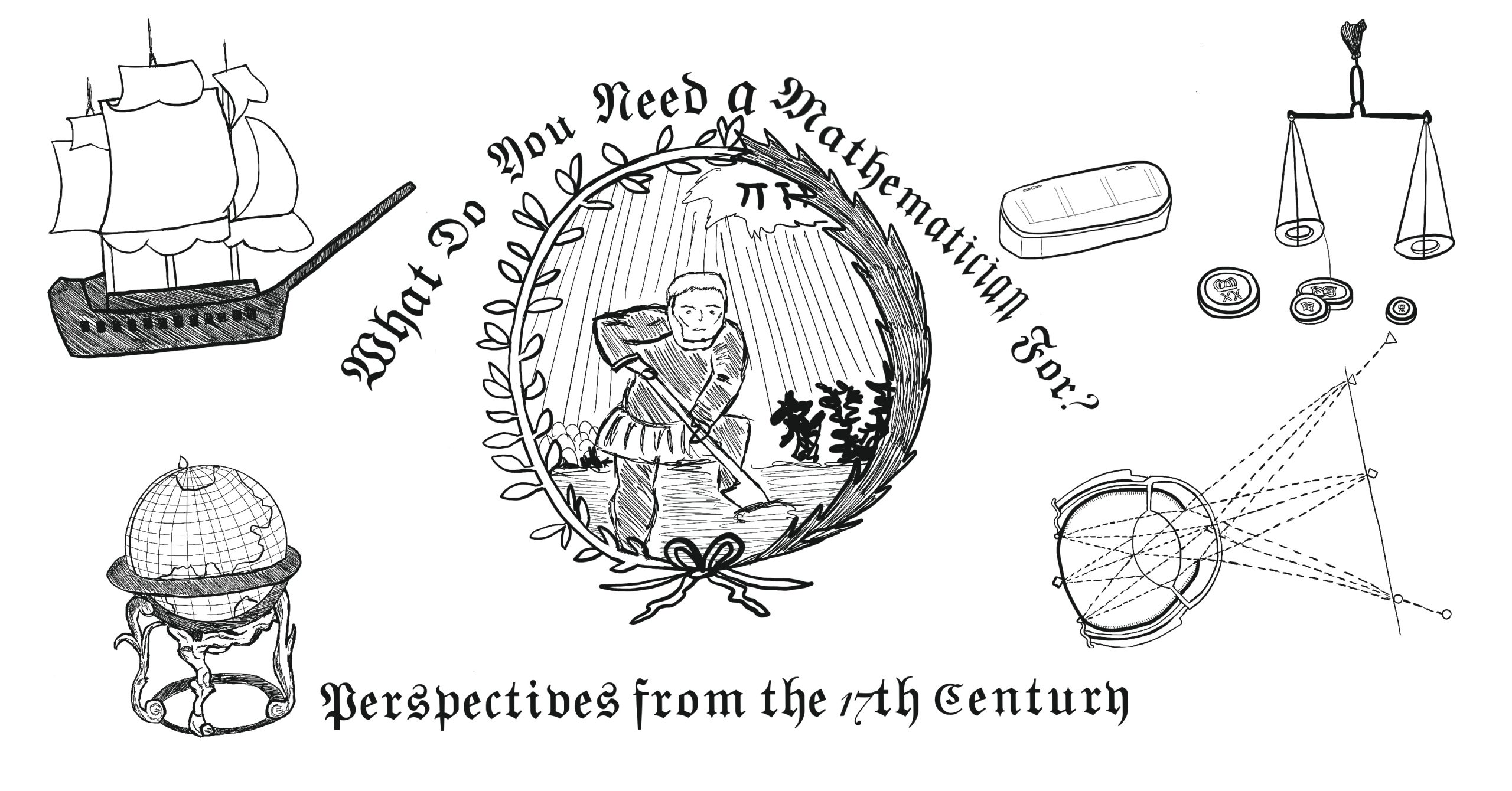
Since 2000, the BSHM has collaborated with Gresham College to host an annual lecture. On October 7, the 2026 lecture, entitled ‘What do you need a mathematician for? Perspectives from the 17th Century’ was given by Professor Volker Remmert.
Professor Remmert teaches the history of science and technology at the University of Wuppertal, Germany. His research interests include the history of early modern science, with a focus on mathematics, and the history of mathematics in Germany in the nineteenth and twentieth centuries.
The lecture followed the prize-giving ceremony for the winners and runners-up of both the BSHM undergraduate and schools essay prizes. This year, the schools’ prize entrants wrote essays on topics in ethnomathematics, defined as the mathematical ideas of traditional peoples and/or a consideration of the broad practices of communities that typically fall outside of the traditional discipline boundaries of the mathematical sciences. Winning entries focused on the mathematics of textiles, navigation, and religious texts, corroborating Remmert’s answer to his titular question: What do you need a mathematician for? Everything.
AI and Mathematics
Professor Volker Remmert began his lecture by addressing some of the recent news concerning the increasingly imposing role of artificial intelligence within mathematics. He discussed the story of Tristan Buckmaster, a mathematician at NYU, who was making significant progress on the Navier-Stokes problem, one of the Millennium Prize problems, before OpenAI claimed a solution in early September.
Remmert highlighted the Leiden Declaration on Artificial Intelligence and Mathematics, authored by 16 mathematicians, that calls for rapid action in acknowledgement of the challenge posed by AI to mathematics research. As Remmert discussed, Buckmaster has highlighted the significance of this moment for how students are trained and how the mathematical discipline functions, with calls for serious, deliberate consideration on how to proceed.
Back in Time...
In search of answers as to where that might be, Remmert took us 400 years into the past to discuss what a mathematician looked like in the seventeenth century, and why they were needed at the time. As seventeenth-century mathematician John Wallace put it, “For Mathematics, (at that time) were scarce looked upon as Academical studies, but rather Mechanical; as the business of Traders, Merchants, Seamen, Carpenters, Surveyors of Lands, or the like; and perhaps some Almanack-makers in London.” Remmert explained that the mathematical sciences in early modern Europe consisted of fields concerning number, measure, and weight. Further, mixed mathematics could include astronomy, geography, optics, music, cosmography, and more.
Horensius and the Importance of Mathematics
Mathematics once held one of the lowest rungs in the hierarchy of the sciences, but the seventeenth century heralded a change in this matter. Remmert used the work of Martinus Hortensius as a case study of the kind of propaganda that succeeded in significantly elevating the status of mathematics during the 1600s.
Hortensius was a student in Rotterdam before moving to Leiden. He interacted with several influential mathematicians in his day, including the prominent Copernican, Philip Lansburg, whose texts he translated from Dutch to Latin. He taught in Amsterdam before gaining a professorship in Leiden, but died shortly after moving there in August 1639.
As Remmert explored, a published inaugural lecture given by Hortensius in 1634 professes the importance of mathematics. He heralds Archimedes of Syracuse as the height of science, who, according to Plutarch, managed to almost single-handedly defend Syracuse from the Romans using his mathematical skill. Ancient Greek mathematicians were evoked to connect mathematics to the ideas of civilisation and great success, but Hortensius then goes further. He suggests that modern mathematics has allowed society to surpass the great ancients. Speaking to some of the more recent developments in astronomy, he highlights the recent discoveries of four objects orbiting Jupiter. Considering that the ancient Greeks did not attempt to investigate these things; Horentsius implies they were clearly inferior to the early modern mathematicians.
Hortensius links Amsterdam’s reputation as a centre of trade to the great navigational, and necessarily mathematical, skill of their sailors. However, he also speaks to the role of mathematics beyond pure utility: “Among pleasures, can any be greater than the mathematical sciences for stimulating the mind itself and flooding the inmost feelings of the spirit with fullest joy?” Mathematics for the purpose of enlightening the soul is further highlighted in religious and cultural imagery across various time periods. Plato claimed that eyes were given to man to watch the stars, and arithmetic and geometry were given as wings by which they might fly into the highest spaces of the world. Remmert provided us with a number of examples of religious imagery depicting winged angels labelled with arithmetic and geometry over either shoulder.
Hortensius’s speech highlights the dignity, nobility, and utility of mathematics, drawing together a compelling case for the mathematical sciences. Furthermore, his speech was not unique. Many similar texts and images from the seventeenth century corroborate this notion. In the view of the early modern mathematicians, mathematics is everywhere you look. Remmert concluded his lecture asserting that if you ask a seventeenth-century mathematician what you need mathematics for, the answer would be simple: everything.
Interested in hearing more? Professor Volker Remmert’s lecture can be watched in full online: https://www.gresham.ac.uk/watch-now/what-mathematician
The following link also allows you to view the catalogue of previous BSHM Gresham College lectures: The Annual BSHM Gresham College Lectures
Further Reading
Buckmaster, Tristan, and Levent Alpöge. Publication of Finite-Time Blowup Results With Smooth Forcing for Incompressible Porous Media, Boussinesq, and 3D Incompressible Euler Equations Research Announcement (2026), available at:https://cims.nyu.edu/~tristanb/statement.pdf.
Imhausen, Annette, and Volker R. Remmert. ‘Martinus Hortensius, Oration on the Dignity and the Usefulness of the Mathematical Sciences (1634)’. In History of Universities, Volume XXI/1, edited by Mordechai Feingold. Oxford University Press, 2006. https://doi.org/10.1093/oso/9780199297382.003.0003.
Taylor, E. G. R., The Mathematical Practitioners of Tudor & Stuart England, Cambridge University Press, 1970.
About the Author
Jessica Taberner is a mathematics graduate from the University of St Andrews. Her research looks at the mathematical education of British women and girls in the early nineteenth century through commonplace and manuscript books.