

History of Mathematics Day, in Honour of John Fauvel
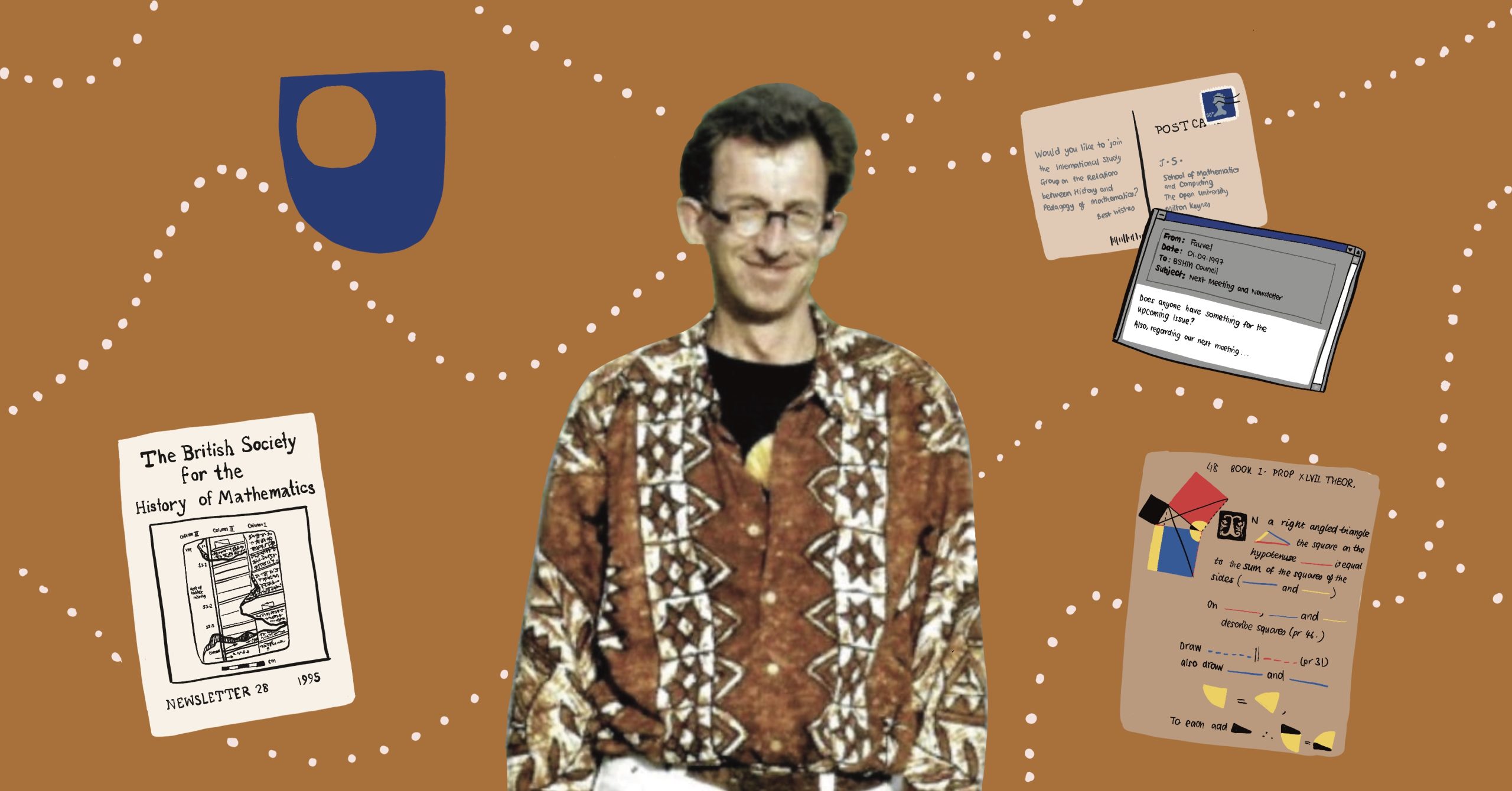
John Fauvel was one of Britain’s most distinguished historians of mathematics. He contributed extensively to teaching at the Open University and to the embedding of history of mathematics into mathematics teaching more broadly. 2026 marks the 25th anniversary of his passing, and as such the OU are hosting a 1-day meeting in his honour.
The day will highlight the research in history of mathematics developed at the OU and look ahead to current research and how this can be used in teaching. We hope to gather together many of those who studied MA290 at the OU – a course John Fauvel co-designed – as well as those who worked alongside him at the OU and elsewhere. The day will consist of talks and a visit to the Fauvel Collection at the OU Archive.
The event will take place in-person at Walton Hall Campus in Milton Keynes, and the talks will be streamed live over MS Teams. There is no registration fee but to attend either in-person or online then you must fill in this form: History of Mathematics Day, in Honour of John Fauvel. 15th October 2026. – Fill in form.
Programme
10.15 Welcome & Registration
10.30 Brigitte Stenhouse, Contextualising the Curriculum through the History of Mathematics
11.10 Elinor Flavell, The career trajectories of female students at Cambridge University, 1873-1890
11.30 Visit to the Fauvel Collection, OU Archive
12.40 Lunch*
13.40 Robin Wilson & Raymond Flood, Working with John
14.10 MA290 video showing
14.30 June Barrow-Green, John Fauvel: Mentor and Friend
15.10 Tea & Coffee Break
15.40 Jeremy Gray, John Fauvel and the early years of history of maths at the OU
16.20 Close of formal proceedings
*Lunch is not provided, but a table will be booked at the Hub Café for attendees to eat together. You can bring a packed lunch or purchase lunch at the café (~£10).
Abstracts
June Barrow-Green, Emerita Professor, OU
John Fauvel: Mentor and Friend
I first met John in 1989 when I was being interviewed for a PhD spot at the OU, and he could not have been more encouraging. Thus began what would become a wonderful friendship. Needless to say, I had barely set foot in Milton Keynes before John had characteristically—and skilfully—persuaded me to stand for the Council of the British Society for the History of Mathematics! Over the years that followed, we shared an office, travelled to conferences across the USA and Europe, taught at OU Summer Schools, and collaborated on projects with the BBC. Gently questioning, he would steer me in new directions with his remarkable knowledge and incredible library always at my disposal. In my talk, I will describe some of the work which resulted and how his influence still motivates and inspires my work today.
Elinor Flavell, PhD student, OU
The career trajectories of female students at Cambridge University 1873-1890
By the year 1890 over 100 women had studied mathematics at either Girton or Newnham College in Cambridge and had faced the question of whether they wanted, or needed, to find a job. Essayists, such as William Rathbone Greg, idealised the Victorian housewife and maligned the working woman, calling them “lonely and destitute…because they have none to love, cherish and obey” (Greg, 1877). While many people seemed to agree with these ideas the reality did not, as current research suggests that less than 25% of the women studying mathematics at Cambridge went on to marry, with the majority instead becoming schoolteachers. Many of these teachers had dynamic career trajectories which spanned thirty or forty years and involved working in different schools around the country (and in some cases the world) to educate the next generation; progressing in role from Mathematics Mistress to Head Mistress.
This talk will analyse the career trajectories of the women who studied mathematics at Cambridge in the late nineteenth century and question if this had an influence on the career opportunities for younger women and girls. That is, how did university-educated women working at multiple different schools impact the jobs that the next generation of women were able to do. Using college registers, personal memoirs and college records we will trace the career trajectories of these women and situate them within the broader context of what mathematical community existed once they had left Cambridge.
Greg, W. R. (1877). Why are Women Redundant? In: Literary and Social Judgements, Vol II, 4th Edition, Trübner & Co., pp.44-90.
Raymond Flood, Kellogg College, Oxford & Robin Wilson, Emeritus Professor, OU
Working with John
In this talk we share some memories of our years collaborating with John on many projects. In particular, Robin will recall John’s acting prowess (!) and his links with Colorado College, while Raymond will reminisce about the books that we worked on with John.
Jeremy Gray, Emeritus Professor, OU
John Fauvel and the early years of history of mathematics at the OU
The idea of a course on the history of mathematics at the OU is due to Graham Flegg. First I, and then John, were brought in to run it as lowly creatures called course assistants, and John did very well at keeping the course alive, but it was clear to him and me that there had to be a new course. By this time, course assistants, who often knew more than their nominal bosses, had been raised to the status of lecturers, and we were able to produce a new course and a remarkably successful source book. John’s loving attention to detail in that book and on the course stands as one of the finer testimonials, I believe, both to him and the first few decades of the OU Mathematics Faculty.
Brigitte Stenhouse, Lecturer in History of Mathematics, OU
Contextualising the Curriculum through the History of Mathematics
Over the past three years, the Contextualising the Curriculum through the History of Mathematics project at The Open University has hosted four undergraduate student research interns. During the internships, students engage with academic literature in history of mathematics in order to identify people, ideas, or artefacts that complement the undergraduate mathematics curriculum; the way in which their chosen histories “complement” the curriculum is left to the student, though they are encouraged to search for lesser-told stories that resonate with their personal interests.
In this talk I will walk through some of the ~15 articles soon to be available on the Contextualising the Curriculum VLE site, reflecting on what knowledge and study skills students can gain from engaging with these resources.