
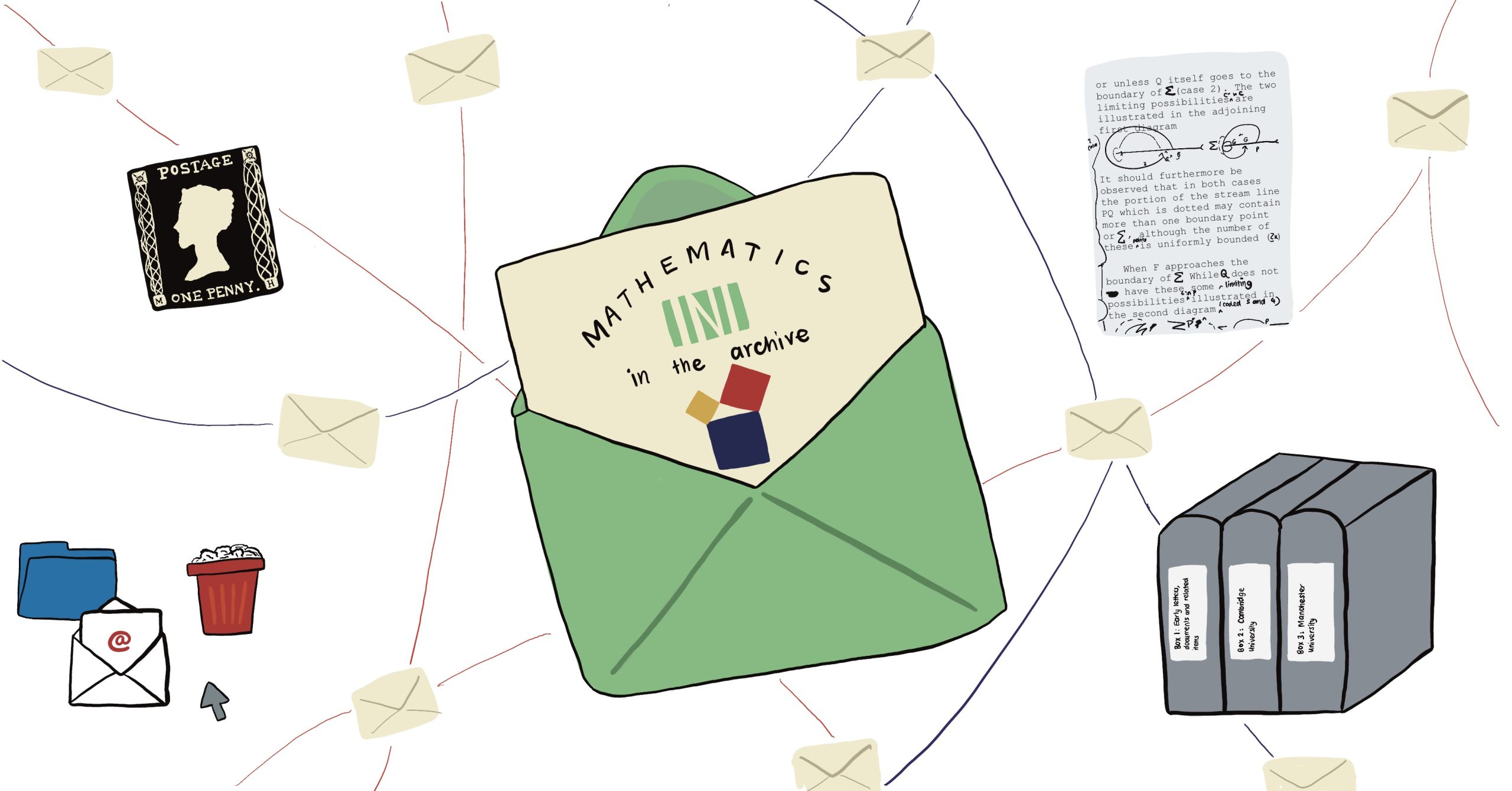
Early on May 16, 2026, mathematicians, historians, and philosophers alike arrived at the Isaac Newton Institute for Mathematical Sciences in Cambridge for the BSHM-INI joint meeting, Doing Mathematics in the Archives. Under the gaze of Sir Isaac Newton’s portrait, presentations of four ongoing research projects commenced: Archives in Mathematical Philosophy: Some case studies by Michael Potter (University of Cambridge), Epistolary Mathematics in the 19th Century by Aoife Kearins (University of Oxford), George Birkhoff’s Forgotten Manuscript by June Barrow-Green (Open University) and Reem Yassawi (Queen Mary University of London) (also in in collaboration with Andrew Burbanks (University of Portsmouth) and Dan Rust (Open University)), and Collective and Personal Archives in the Genesis of Bourbaki’s Set Theory Book by Emmylou Haffner (CNRS). Insightful discussions on doing mathematics in the archives ensued, tackling themes such as the role of correspondence in mathematical history, the development of mathematical terminology, and the digitization of archives.
Mathematics by post
In 1839, 79 million letters were sent across England. This may already seem significant but only two years later, 208 million letters were sent! Aoife Kearins explained how the penny post was behind this growth, issued for the first time on May 1, 1840. Affordable postage increased correspondence countrywide, but also marked a pivotal point for mathematical correspondence. It is no wonder that Sir George Stokes (1819–1903) was known as the “Victorian correspondent”—his archive consists of 30–35 thousand letters! By investigating Stokes’s letters and intricate web of correspondents, Aoife showed how Stokes’s dedication to correspondence increased collaboration between mathematicians and the mathematicization of science. The importance of correspondence for connections and discourse continued through the 20th century. June Barrow-Green and Reem Yassawi emphasized the importance of letters in better understanding the background and content of George Birkhoff’s (1884–1944) unpublished manuscript, ‘Some Unsolved Problems in Theoretical Dynamics’. Emmylou Haffner also explored correspondence between Bourbaki founders Jean Dieudonné (1906–1992) and Henri Cartan (1904–2008), in which they contended with certain epistemological concerns about set theory and logic. More well-travelled, the transatlantic correspondence of British philosopher Peter Geach (1916–2013) and American logician and philosopher W. V. Quine (1908–2000) between 1949 and 1999 was one of Michael Potter’s case studies on the archives of mathematical philosophers.
Technical terminology
Mathematical terminology was a central challenge for June and Reem’s attempts at the problems in Birkhoff’s manuscript. On top of his opaque writing style, Birkhoff’s manuscript is filled with obsolete 20th-century mathematical terminology. Some of the more difficult terminology has been decoded, for example, in Problems 2/3, Birkhoff writes ‘regional transitivity’, which is modern-day ‘transitivity’, and ‘recurrent’, which is the same as ‘uniformly recurrent’ or ‘minimal’. Problem 4, however, remains a mystery: geodesic flow and geodesic space appear to have a nonstandard definition and therefore are difficult to parse. In the same vein, Michael addressed the challenge of transcribing and translating Kurt Gödel’s (1906–1978) notes written in Gabelsberger, a German-origin shorthand, and Geach’s letters written extensively in logic notation. On the other hand, Aoife’s and Emmylou’s research underscored processes of standardization of mathematical terminology. As a result of his prolific correspondence, Aoife argued that Stokes had a significant influence on the standardization of mathematical language. Stokes used his web of connections and status as an authority in mathematics to influence word choice in mathematical publications for over 30 years. Similarly, Emmylou explained that Bourbaki had collectively developed a cohesive mathematical language and solidified standardized reading and writing practices for the community; although, based on the Dieudonné and Cartan correspondence, this was not without its challenges.
Digitizing the archives
In the age of technology, many digitized libraries and academic databases can be accessed anywhere, at any time. Archives are no exception. You can access the Bourbaki archives (archives-bourbaki.ahp-numerique.fr) at the push of a button without even leaving your bed. Michael highlighted several archives that are similarly accessible: Frank P. Ramsey’s (1903–1930) microfilm archive is available on Pittsburgh University’s library website (https://digital.library.pitt.edu/collection/frank-plumpton-ramsey-papers) and Max Newman’s (1897–1984) archive at St. John’s College, Cambridge is largely online (https://www.cdpa.co.uk/Newman/MHAN/). Others, however, can only be viewed at the physical location, for example, G. E. Moore’s (1873–1958) archive, consultable only at the Cambridge University Library. While the increased digitization provides greater accessibility to the archives, Michael argued that physical archival research still has unique benefits, especially for qualities of documents you can only identify in person. Furthermore, Michael concluded on some future implications of the increasing digitization of archives and of everyday written documents, such as correspondence, notes, and drafts. Digital sources such as institutional e-mails, text messages, digital notes, and Word documents can be subject to total deletion, at the latest on the death of their creator, therefore becoming impossible to archive. In the Q&A portion, Aoife touched on a similar topic: As a result of increased correspondence, the Royal Society began linking membership to publication, causing smaller results to be published more frequently, just as modern communication technology and academic institutions demand the same. The BSHM-INI meeting was an important moment of reflection, raising awareness of the fact that as technology continues to accelerate our access to resources and one another, we must consider access, preservation, and management of archives in a digital age.
About the Author
Esther Rose Kassel is an MPhil student in Classics at the University of Cambridge. Her research investigates professional and pedagogical ancient Greek mathematical practices through papyrological evidence.