BSHM

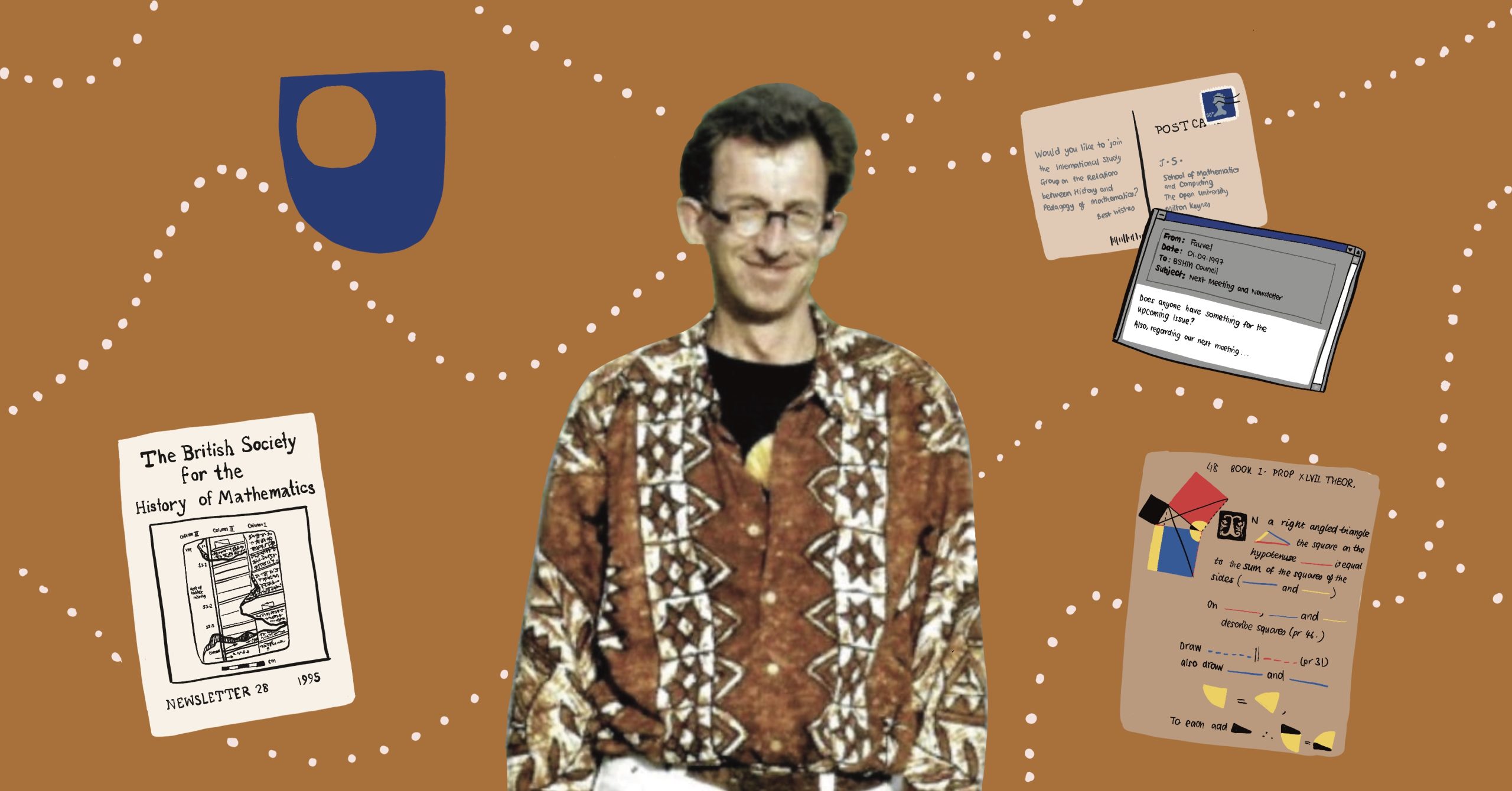
Photograph of John Fauvel with various doodles relating to his life including The Open University logo and a page of Byrne's Euclid Elements.
Source of original image: BSHM Newsletter Volume 45 (2002). Additional Illustration: Megan Briers.

May 12th 2026 marks 25 years since the death of John Fauvel, one of Britain’s most distinguished historians of mathematics. In honour of his achievements and his tireless commitment to the BSHM, this year we have launched the John Fauvel Invited Lecture, which will take place annually at our Research in Progress Meeting. We also wish to bring attention to the Fauvel Collection of books as a valuable resource in the history of mathematics. What follows is a snapshot of Fauvel’s life and work, heavily based on volume 45 of the BSHM Newsletter (Spring 2002), and an introduction to the Fauvel Collection. 

About Fauvel

Born in Glasgow, John Fauvel studied mathematics at Essex University. He then pursued postgraduate study at Warwick University, graduating with an MPhil in Mathematics in 1977. He had already joined The Open University as an Associate Lecturer in 1974 and in 1979 was made a permanent Lecturer in Mathematics. He remained in the Mathematics (later the Mathematics and Computing) faculty at the OU until the end of his life. 

Fauvel’s research covered many topics across the history of mathematics, and he was especially active in promoting the use of history in education. His publications did much to recapture the communities in which British mathematicians operated over eight centuries and enabled mathematics teachers to use rigorous historical content in their classroom with purpose. Fauvel’s scholarship was noted for his full command of the subject under consideration, a dry humour, and a readable prose style, as well as the inclusion of a wide variety of illustrative figures and images. He was a keen advocate for the importance of good communication in a variety of mediums, and he once received criticism from a fellow scholar for having given such a lively and engaging after-lunch talk that the latter had been kept from their usual postprandial nap. 

Writings and the BSHM

Published writings give but a limited snapshot of Fauvel’s work, as he published far less than he knew; much of his knowledge was shared generously with colleagues through conference talks, conversations, postcards, and, later, emails. Fauvel placed a high value on community, and one of his great strengths was putting people in touch with each other. He chaired the International Study Group on the Relations between History and Pedagogy of Mathematics, and co-chaired the International Commission on Mathematics Instruction study on The role of the history of mathematics in the teaching and learning of mathematics, the outcome of which was published in 2000. He was also an editor for journals which spanned the disciplines of education, history, mathematics, and philosophy.

Fauvel was the president of the BSHM from 1991-1994; it was under his leadership that an annual meeting was introduced at which students would share their research in progress and a keynote lecture would be delivered by an established scholar. The BSHM’s Research in Progress meeting is now a key and annual feature of the society’s calendar. At the most recent meeting, the keynote lecture became the inaugural John Fauvel Invited Lecture, given by Professor Tinne Hoff Kjeldsen.

From 1995 to his death Fauvel was editor of the BSHM Newsletter, and he took this publication from a modest pamphlet to a mature publication that fostered a valuable sense of community amongst the scattered society members. The Newsletter has since morphed into the society’s academic journal, the British Journal for the History of Mathematics.

Community and Campaigning

An emblematic quality of John Fauvel as a person and a scholar was his generosity; he cared deeply for others and invested his energy towards their wellbeing and flourishing. According to his long-standing colleague Jeremy Gray: “An openly gay man, [John] lived his life positively and joyously, with great good humour and tolerance… He campaigned energetically against laws, persons, and practices responsible for injustice, bringing to bear the same sharp intelligence that characterised his academic work”. And from his former PhD student, Jackie Stedall: “For John, doing mathematics or history of mathematics, exchanging postcards, sharing a meal, were all part of what it was to be human and alive. John didn’t just help me to write a thesis, he helped me to value the experience, and to feel that what I had to say was worth saying”.

During his tenure at the OU, Fauvel was heavily involved in the teaching of history of mathematics to OU undergraduates, including both those with and without a mathematics background. He was committed to ensuring that OU materials offered students a high-quality experience, operating on the assumption that, even if the students were not yet well-informed about the history of mathematics, they were intelligent, interested, and not to be patronised. Together with Jeremy Gray, he radically transformed the style of teaching materials and assessment when the history of mathematics module at the OU was rewritten as MA290. This work resulted in the widely adopted textbook History of Mathematics: A reader (1997), which taught students that historians must look far and wide for evidence of mathematical practice – in philosophy, writings on music, non-canonical sources, and more. 

Fauvel’s passionate conviction of the importance of public access to historical artefacts led, in 1997, to his campaigning to prevent the destruction of the grave of Jewish mathematician J. J. Sylvester (1814-1897) at Balls Pond Road Cemetery. A year later his convictions brought him into direct conflict with the University of Keele when they secretly sold Charles Turner’s collection of antiquarian maths, science, and technology books and manuscripts into private hands. He traced many of the works to auction houses, facilitating the University of Nottingham’s purchase of William Thomson, Lord Kelvin’s personal – and annotated – copy of George Green’s groundbreaking 1828 essay on electricity and magnetism for their Green Collection. Some works from the Turner collection were saved by Fauvel directly and are still held in his collection of books. He spent much time with fellow bibliophile and BSHM member David Singmaster on exposing the sale, and the latter described Fauvel as “superb as a crusading polemicist”.  Fauvel’s fury at the sale was featured in an article printed in the Daily Telegraph, shown in Figure 1.
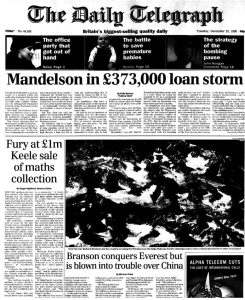
Front page of the Daily Telegraph from December 22nd 1996 with article entitled "Fury at £1m Keele sale of maths collection"
Figure 1: Front page of the Daily Telegraph from December 22nd 1996 with article entitled “Fury at £1m Keele sale of maths collection”

At the time of his death, Fauvel had amassed his own private collection of books numbering over 2,500 volumes. These were left to the BSHM, alongside a bequest of £15,000 to promote links between history of mathematics and mathematics education. True to his ethos in life, the Fauvel Collection of books were deposited at the OU where they are available to be consulted by scholars and interested parties. The main strengths of the collection are in Greek mathematics (particularly Euclid’s Elements), 16th-18th century British mathematics (particularly the work of Isaac Newton), Oxford mathematics, the history of computing, ethno-mathematics, and the use of history in mathematics education. There is an extensive reference collection, as well as a number of collected works, several editions of correspondence, and a wide range of 19th century mathematics textbooks. One especially notable work in this collection is Oliver Byrne’s 1847 edition of the Elements, in which the results are explained through the use of diagram and colour, and from which the BSHM Logo is derived. 

Although I (Stenhouse) was not privileged enough to know him personally, Fauvel’s influence on the scholarly discipline and broader community have certainly shaped my own journey over the past decade, and I am grateful to have benefited from the networks and spirit of collegiality that he fostered. I am sure he would be pleased to know that his collection is a living artefact, continuing to contribute to our knowledge of mathematics and its history. 

Arithmetic for Ladies

We conclude this blog with a brief look at items from the Fauvel Collection used by current PhD student Elinor Flavell to investigate women’s access to mathematical ideas (relevant twice-over on May 12, Women in Mathematics Day). 

The Fauvel Collection holds several books that fall under the category of “arithmetic for ladies”. These are books on arithmetic normally published in the late 18th to early 19th century and include in their title something along the lines of “intended for the use of young ladies”. Now, you might look at the time period these books were published in, glance at the title, and think you have a pretty good idea of what the book will contain. However, there are a few surprises… 

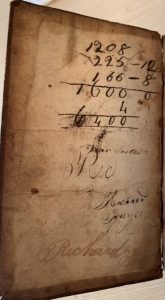
A page of Robert Goodacre's 1805 “An abridgment of Goodacre’s Arithmetic intended for the use of young ladies and others, whose avocations will not allow them to spend much time in the study of this science” showing Richard Synyer's signature.
Figure 2: Showing Richard Synyer's signature. From Fauvel Collection 511 GOO. Image is Flavell's own.

One such book, written by Robert Goodacre in 1805, was named “An abridgment of Goodacre’s Arithmetic intended for the use of young ladies and others, whose avocations will not allow them to spend much time in the study of this science”. Succinct. Looking through, it follows the pattern of a modern textbook. You want to learn about multiplication? There is an explanation, a few examples, and some questions for the reader to go away and try. The surprising thing about this book is, despite the “young ladies” in big, bold font on the title page, it was owned by a man. We have cunningly deduced this from the fact that a “Richard Synyer” has written his name all over the book, as seen in Figure 2. No information on who Synyer was has yet been found but it is nonetheless a great connection to the past.

Another interesting book is William Butler’s “Arithmetical tables designed for the use of Young Ladies” published in 1810. You could think of this book as a Georgian version of Google. How often in your daily life do you ask a search engine to convert between two different measurements? Well, in 1810 you could just open up “Arithmetical Tables” and find pages and pages and pages of tables for converting between different weights and measures. There is a wine measure which is different to an ale and beer measure, which is different again to a dry measure. My favourite conversion is that a firkin of butter is 56lbs, but a firkin of soap is 64lbs – who knew! 

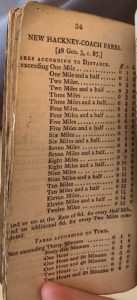
The book is about the size of a smart phone and much lighter, making it a portable item to double check any calculations you may be doing. Furthering the smart phone analogy, the book continues with an impressively large, if seemingly random, array of information. Do you need to know how many days William the Conqueror reigned for? The book has you covered. Want to know the birthday of the Duchess of Wirtemberg? No problem. The book has information on astronomical signs, populations of different countries, the number of convicts in the UK (1,410, if you are interested), and the price of a journey on a Hackney coach.  For a book called “Arithmetical Tables”, there are definitely tables; and there is arithmetic but maybe not quite as we know it.

A page in William Butler’s 1810 “Arithmetical tables designed for the use of Young Ladies” showing the price of fares on the Hackney Coach.
Figure 3: A page showing the price of fares on the Hackney Coach. From Fauvel Collection 511 BUT. Image is Flavell's own.

You can find out more about consulting the collection and search the catalogue on the OU website. We sincerely encourage scholars to make use of this excellent resource, and you are welcome to reach out to Dr Brigitte Stenhouse if you have any questions. 

About the Authors

Dr Brigitte Stenhouse is a Lecturer in History of Mathematics at The Open University. Her research considers the importance of gender and domesticity in the building of mathematical careers, and she is especially interested in the life and work of Scottish mathematician and science writer Mary Somerville (1780-1872). 

Elinor Flavell is a historian of mathematics with a focus on the mathematical education available to women in the nineteenth century. She is currently a PhD student at the Open University with Dr. Brigitte Stenhouse as her supervisor. Elinor loves history, maths, and most things in between.