
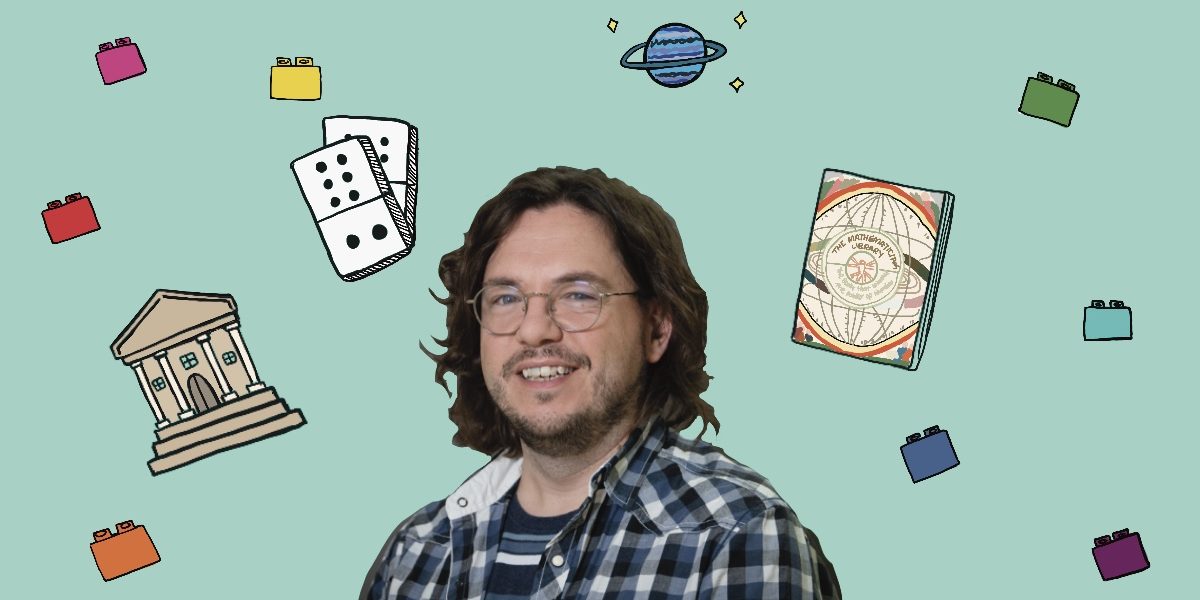
At our Christmas 2025 AGM, we elected Tom Briggs as our newest ordinary council member. This blog introduces Tom, his interests and his journey into the history of mathematics!
Who is Tom Briggs?
I’m a freelance museum learning consultant encouraging museums and other public-facing organisations to recognise mathematics as an integral part of their story that’s worth exploring with audiences: I provide training to help staff examine their own relationships with mathematics, and then to look past popular misconceptions about the subject to find the rich, meaningful, and engaging mathematical themes that are often bubbling just below the surface. Then I support their exploration of these ideas, advising on communicating mathematics to their audiences.
Maths is a hobby for me too: I run my local MathsJam – a monthly meetup with fellow maths-fans in a local pub, where we share puzzles we’ve come across recently, and card games or dominoes are not an unusual sight! I’m an avid reader, and as well as consuming explicitly maths-relevant books I’m a keen spotter of mathematical themes in ostensibly ‘not-maths’ books – whether fact or fiction. I’ve recently made my own contribution to the pop-sci bookshelves: The Mathematicians’ Library was published in September 2025. I think this officially makes me an author, though it still feels weird saying it out loud!
In my spare time I like to visit the cinema and play my guitar (though not at the same time), and some would argue that I have rather too much Lego.
How did you get interested in the History of Mathematics?
During my undergraduate degree (BSc (Hons) Mathematics with Astronomy, 2001-2004) I studied a module on the history of mathematics, thoroughly enjoying it and achieving a higher grading than in any other. Unfortunately, it did not occur to me that history of maths was something that could be pursued as anything other than an interesting distraction from ‘doing maths’. Around twenty years later I made a new friend who introduced me to the BSHM, specifically Research in Progress. My eyes were opened not just to the history of mathematics as worth exploring and researching in and of itself – and that there were plenty of people doing exactly this – but also that some of my own work and research intersected with this sphere: assignments toward a PgCert in Digital Leadership explored maths-focused resources offered by museums; my MA research project explored how maths-themed visits to museums might affect attitudes to maths exhibited by participating secondary school students. My first RiP was such an inspiration that I haven’t missed one since, and I even co-presented a session (with Jason Yip) at 2025’s, teasing early findings after teaching a half-term’s worth of maths lessons infused with history of maths themes to two secondary school maths classes.
What do you hope to achieve with your time on council?
I’m completely new to being on a council for anything, so the main thing I hope to achieve is working out how I can be an effective and useful member of the BSHM council! One of the reasons I was offered this position in the first place was that I am a qualified secondary mathematics teacher; a professional demographic that isn’t currently well-represented amongst the BSHM membership. Though not currently practicing (I left my part-time role at Easter, 2025, to focus on my freelance work), I am an outspoken advocate for teachers in a society that is often a little too quick to (figuratively) beat them with thorny branches when the subject of widespread societal negativity to mathematics comes up. As a teacher, membership of the BSHM undoubtedly affected my practice: I would like to help other teachers like me discover it earlier in their careers than I did; and to help shape it as a professional organisation that stands out amongst the various others competing for their attention (and subscriptions).
Quick fire questions
(Mathematical) likes?
I have become increasingly interested in the role of mathematics in historical developments, achievements, and discoveries, especially where these developments are not generally considered to be ‘mathematical’ by the general public. I don’t have specific interests in any particular area of mathematics; I’m more fascinated in its place as a highly creative discipline that can be uncovered as a supporting structure behind humanity’s development throughout the whole of its history.
(Mathematical) dislikes?
I dislike the unfair, unfounded, yet prolific and seemingly unstoppable avalanche of misconceptions and outright falsehoods about mathematics and what qualifies people as ‘good’ or ‘bad’ at it that flood modern society: common perceptions that reduce this vast and varied discipline to mere feats of mental arithmetic; that it exists separately from human creativity rather than being arguably the most fundamentally creative – not to mention the oldest – of all human endeavours.
Favourite number?
I cannot choose, nor would I want to, in case any of the infinite others should feel left out.
If time machines existed, would you go forward or backwards, and why?
Probably forward: I can learn about the past from books and through science; but the future is unknowable to any of us until we get there; and there are parts that we will never reach. Learning from the past is an important part of why we study it; but can you imagine the possibilities afforded by learning from the future?
Which historical character(s) would you want to have a dinner party with, and why?
Theming this dinner party’s guest list mathematically, I think I would like to spend time with some of those historical figures who have arguably contributed to mathematics but are not primarily described as ‘mathematicians’ when they turn up in museum exhibitions: Florence Nightingale, Sir Christopher Wren, Ada Lovelace, da Vinci… I feel that some of these people might have interesting takes on mathematics and its place in society.